Coelacanth News!
The world's most complete coelacanth bibliography links off the bottom of the Biology and Behavior page.
March, 2025: OceanXplorer conducts African coastal research
In the winter of 2025 a new billionaire’s research vessel, the OceanXplorer visited the Comoros and South Africa. This specially designed marine research vessel was the brainchild of Ray Dalio and his son Mark Dalio. It was equiped with two Triton submersibles named Nadir and Neptune, and large deep diving ROVs, as well as research and media labs. The team mapped and photographed a massive seamount south of Madagascar on the Madagascar ridge south of Walter’s Shoal. They did not report on any coelacanth sightings there or in South Africa.
October, 2024: Coelacanth observed by divers for the first time in Indonesia
In October, 2024, a close- circuit rebreather diving expedition in Indonesia, funded by the watch company, Blancpain, located a single coelacanth in the region of North Maliku, south of the other known Indonesian locations but within the East-West area of previous observations. What was new was that the coelacanth was observed by divers for the first time in Indonesia, rather than by submersible or ROV. On two separate days, the same individual was observed at a depth of +/-140 meters by divers Julien Leblond and Alexis Chappuis. Interestingly, the water temperature at that depth was within the acceptable coelacanth range, 19-20° C, something we had not observed at the same latitude in the Solomon Islands back in 2019. The fish “was gently hovering above a large rock located on the slope and covered with benthic fauna, mainly sponges and soft corals” The divers noted that the coelacanths in Indonesia are not always in caves or under ledges as elsewhere.
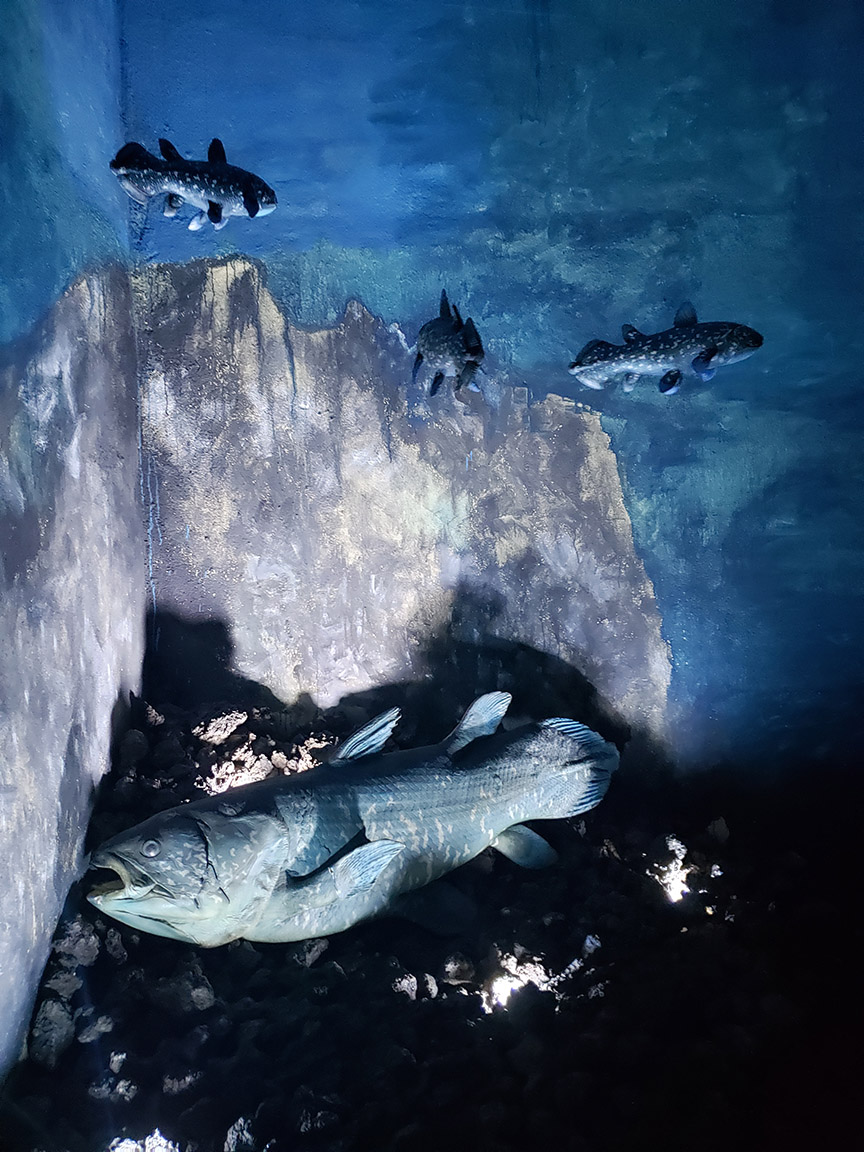
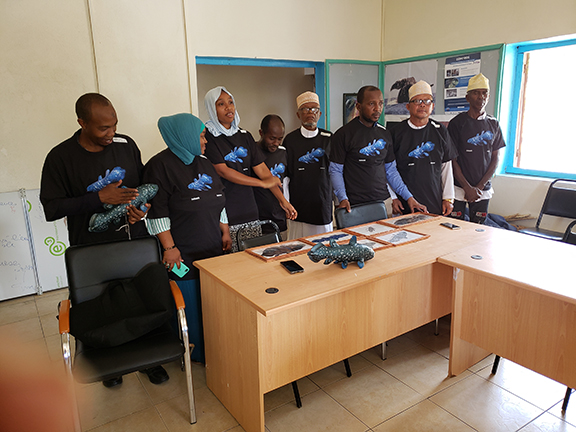
November-December 2022: Time Portal: A static "coelacanths in a cave exhibit" was installed at the Coelacanth Center in Itsoundzou, Grand Comoro (Comoro Islands.) This happened during a visit by Jerome Hamlin of dinofish.com who supplied the T shirts and models, and Diana Dyjak Montes de Oca who did the installation. The real coelacanth caves are just several hundred feet away.
2022, Feb 25 and March 8: Two new sightings of coelacanths at Pumula, South Africa by Mike Fraser, his son Moo and friend Bruce Henderson.
The significance is that this area is 330km south of the "known" population in Sodwana, South Africa. See the 2019 entry below.
(info courtesy Aryn Guiney)
COELACANTH UPDATES 2019 (courtesy Rik Nulens)1) 50th Anniversary of the JLB Smith Institute, now South African Institute for Aquatic Biodiversity (SAIAB) & being 20 years a ‘National Facility’ of the National Research Foundation (NRF) in Makhanda (formerly known as Grahamstown), South Africa.On 13th December 1968, the Council for Scientific and Industrial Research (CSIR) and the Rhodes University in Grahamstown (now Makhanda) jointly resolved to establish the JLB Smith Institute of Ichthyology in a new building in Somerset Street in honor of JLB Smith, and appointed Miss Margaret Mary Smith (nee Mcdonald) as the first director.The South African ‘Science and Technology’ landscape was in the transformative grip of the new Science and Technology Policy of National System of Innovation, and in April 1999, as of the beginning of the 1999 - 2000 financial year, the Department shifted the Institute to the new National Research Foundation (NRF) as a ‘National Facility’.[source: SAIAB 50 years - The Directors’ Cut - Perspectives 1969-2019, edited by Miss Penny Haworth, November 2019]2) New coelacanth books !!!Two announced publications from last year are available now:• Mike Bruton, 'Curator and Crusader. The Life and Work of Marjorie Courtenay-Latimer'.Paperback ISBN 978-0-6399326-9-9• Lionel Cavin, ‘Cœlacanthe : un poisson énigmatique’. Paperback ISBN 979-10-318-0337-1(link no longer active)And a new one, published in Japan is also available!• Masa Iwata, ‘I want to see a living coelacanth!’ (in Japanese only)Book for children. Paperback ISBN 978-4-406-06364-73) Prof Hans Fricke retires !?In a mail message Prof Hans Fricke wrote: …Nur eine Erinnerung, dass ich nicht mehr als ganz Taufrischer noch im Wasser tätig bin, gerade kam ich vom Tauchen vom Roten Meer zurück…Hans Fricke (born 1941) announced his new book to be published March 5, 2020 under the title:‚Unterwegs im blauen Universum‘, ca. 350pp. Well illustrated with (mostly) colour images. Hard Bound book with dust jacket, ISBN 978-3-86971-202-4.Of course, one will find the ‘Quastenflosser’ (Coelacanth) as well in this book.4) The Award winning Coelacanth Brewing Company, 760 A West 22nd St. Norfolk, VA 23517 closed their doors after four years 2015-2019Last year we wrote that the VIMS-coelacanth needed a new ‘home’ and the Coelacanth Brewing Company Norfolk (opened December 2015, founded and owned by Mr Kevin Erskine) joined forces with VIMS on May 11, 2017 to help raise money for a new tank so that the coelacanth can take her rightful place back in the visitor centre at VIMS. The slogan was “Come help this handsome bastard to get a new home. Every beer you buy goes towards replacing the tank!” was a great success which resulted that April 2018 the opening of that new home at the VIMS Visitors Centre was a fact. The specimen remains in a 70% ethanol liquid.But now came the news to us that the brewery will close their doors December 29, 2019, definitely !5) We mentioned in an earlier overview that there is an ‘unknown’ coelacanth in the wet collection of the Great North Museum (the former Hancock Museum) in Newcastle upon Tyne (UK). Thanks to a note from the French scientist Daniel Robineau in the archives at the MNHN in Paris we know now that this is CCC 85. So from now on one can find this Newcastle specimen in the CCC records.6) NEW Coelacanth in Indonesia (CCC 306)See the update for additional details7) Two ‘older’ stuffed coelacanths were discovered.One at the Museum in Charleville Mézières (CCC 307) and another one at the Pukyong National University in South Korea (CCC 308).• The first one was a private gift from a former teacher who worked in a school in Mutsamudu, Anjouan. (personal communication with the responsible from the SHNA Museum in Charleville Mézières). The museum is closed since 1970 but the coelacanth is still there.• The second one was a presidential gift from the Comoro president Ahmed Abdallah Abderemane to Korean president Chun Doo-hwan on occasion of his visit in Korea on October 15, 1986.(personal communication with the responsible at the Pukyong University Museum)8) NEW Coelacanth caught Anjouan, Comoros (CCC 309)See the update for additional detailsIn fact there are now the 323 specimen known, due to the 14 ‘Additional’ coelacanths CCC Ad 1 .. Ad 14] in the catalogue.9) Coelacanths on travelSeveral coelacanths from the MNHN in Paris are on display from 3 April 2019 until 5 January 2020 at the Exhibition “Océan une plongée insolite” in the ‘Grande Galerie de l’Évolution’ of the MNHN (Muséum National d’Histoire Naturelle) in Paris, France.• Skeleton of an adult set in resin = CCC 7• Adult in formalin solution = CCC 8• juvenile with yolk-sac in formalin solution = CCC 29.5• young in formalin solution = CCC 9410) Special issue on CoelacanthsIt happens not so often but the Kitakyushu Museum of Natural History and Human History, (Kitakyushu, Japan), published in 2019 a special issue of their magazine dedicated on the coelacanth. It contains seven (7) articles written by an international team of researchers. Included are: Mawsoniid coelacanths, Triassic coelacanths, field surveys in Indonesia, the first observed living juvenile, morphological measurements on the seventh Indonesian coelacanth specimen etc. For details see the updated bibliography. Most of them are available online.Other contributions on the Indonesian coelacanths were published in the Proceedings of the 10th INTERNATIONAL AQUARIUM CONGRESS FUKUSHIMA 2018Theme: Think about Our Future on the Water PlanetDate: 2018. November, 7-10 at the Onahama Fish Market(these contributions are online available)11) In South Africa, divers encountered a coelacanth on Friday 22 November 2019 at Pumula, some 330km south from the ‘known area’ Sodwana Bay ( iSimangaliso Wetland Park).12) Many of us were in East London (SA) to attend The International Coelacanth Conference* at the end of October 2003 in the EL Town Hall together with Dr Marjorie Courtenay-Latimer, ‘the guest of honour’. It was really an excellent opportunity for interaction between researchers, scientists, marine biologists, environmental educators, public aquarium managers and museum curators.Later, there was a possibility to visit ‘Latimer’s landing’ at the EL Port, the restaurant & the jetty.But since then the jetty at ‘Latimer’s landing’ was degenerating and became dangerous. Now there is the good news that there are plans (and money) for the Proposed Rehabilitation and Refurbishment of the existing Latimer’s Landing jetty at the Port of East London.* This was the first header. Later, it was changed into : “The Coastal and Ocean Exploration Conference” to reach a broader public.
"Makai"
Hawaii's Bishop Museum conducts a mesophotic (twilight zone) reef fish survey in the Solomon Islands, in search of new species, finding several candidates. Leader, Richard Pyle, notes temperatures too warm for coelacanths at most of the study sites. (Family, friends, fellow voyagers, and the scientific community mourn the loss of scientist-diver Josh Copus in a diving accident during the survey.)
NEW COELACANTH DISCOVERY IN SOUTH AFRICA!
Hundreds of kilometers south of the known colonies at Sodwana, diver Alan Fraser, and a group of friends, spotted a coelacanth near Puluma in late November, 2019. The sighting on South Africa's east coast, south of Durban, is reportedly the second shallowest ever recorded at 72 meters, and occurred in a submarine canyon near the mouth of a river. Apparently the group had been unable to get diving permits for Sodwana. There will undoubtedly be follow up dives in the area.
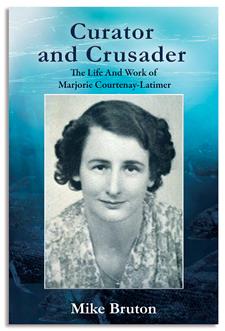
Mike Bruton, ex-director of the JLB Smith Institute of Ichthyology (now the South African Institute for Aquatiic Bodiversity) in South Africa, has followed the publication of his biography on Professors JLB and Margaret Smith ('The Fishy Smiths') with a comprehensive biography on the other key figure in the discovery of the first coelacanth, Dr Marjorie Courtenay-Latimer. Marjorie, who lived from 1907 to 2004, was the first director of the East London Museum (1931-1973) and an important pioneer in botany, anthropology, palaeontology, conchology and ornithology in South Africa yet she is best known for her role in the discovery of the first coelacanth in December 1938.
Mike had access to rich unpublished source material for his biography, including the diaries of Marjorie's father, Eric Latimer, and Marjorie's own diaries, scrapbooks, letters and unpublished notes, and has produced a highly readable and detailed account of her fairytale life, often stranger than fiction. A mystery egg (is it a dodo's?), a wandering hippo, an enigmatic human skull, a secrat visit by a famous aviator, a mysterious monster, the most famous fish in the world (new insights on the coelacanth discovery), a museum ghost, and rugged expeditions into remote parts of southern Africa in the 1930s and 1940s to collect specimens, were just some of the ingredients in her colourful life.'
The book, 'Curator and Crusader. The Life and Work of Marjorie Courtenay-Latimer' (ISBN 978 0 6399326 99; 292 pages) was published in July 2019 by Footprint Press in Cape Town and can be bought directly from the publisher, David Hilton-Barber (david@footprintpress.co.za) .
A new coelacanth [Indo 9 – CCC 306] has been caught in Papua Indonesia last Saturday [June 15, 2019]. Same area as the one captured last year [Sorong district].The specimen is less than 1 meter in length. A team is there to do the measurements and the follow up so this time the specimen will be saved for further research.(courtesy Rik Nulens)
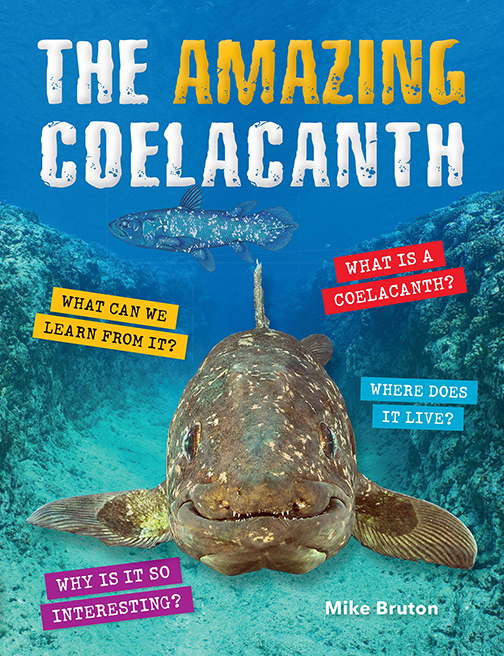
Informative new book for young and (not so young) people is now out from Mike Bruton (see bio ref below.) Profusely illustrated, "The Amazing Coelacanth" fills the gap between Google and the many dense scentific publications. (Penguin Randomhouse, South Africa)
Cute Cardboard Puppet Cutouts retell story of the Coelacanth. Good intro for kids. Usual suspects narrate. Copy and paste link in browser. Inoperative off this site: https://www.nytimes.com/video/opinion/100000004105667/animated-life-coelacanth.html?playlistId=100000003465947
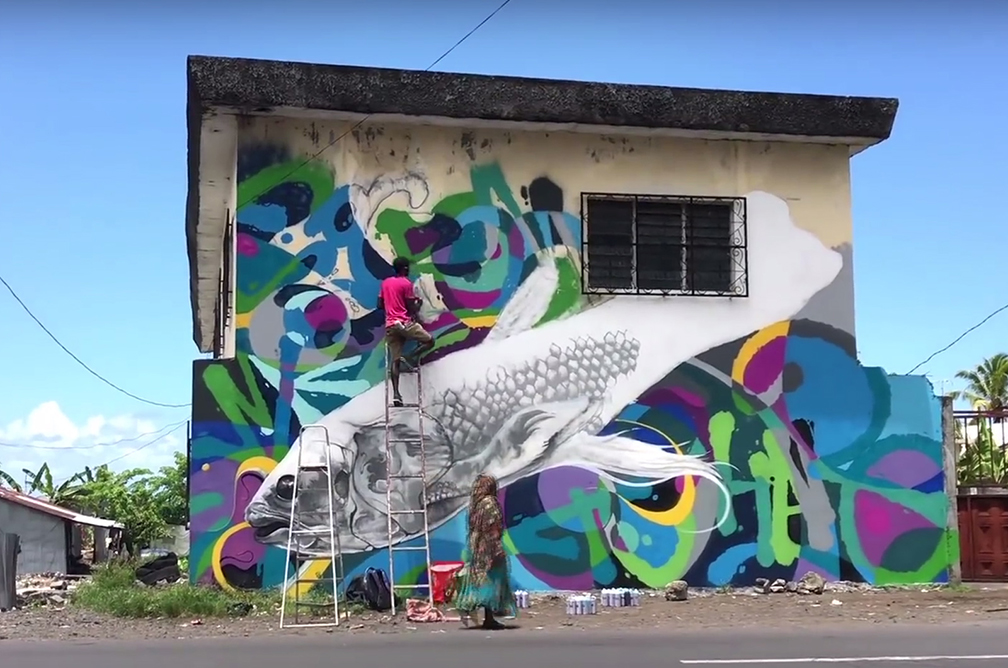
Coelacanth Wall Mural created in Moroni Comoros by a local art group, Swana Creative Studio, promotes the famous fish.
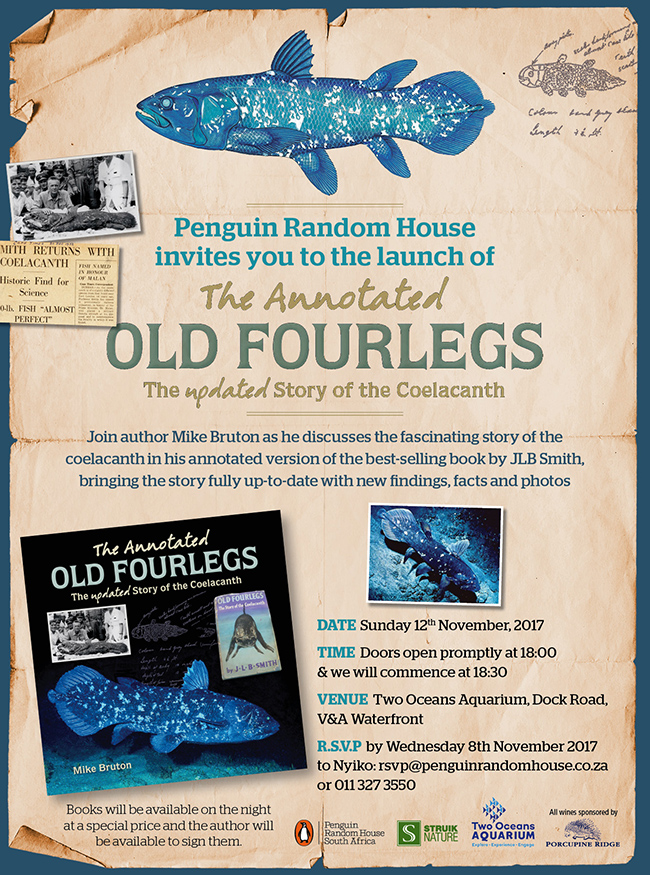
Mike Bruton, former director of the J.L.B. Smith Institute (SAIAB), authors new book bringing the coelacanth up to date.
Coelacanth News 2016 Coela-Center Persists 11 Years after Opening
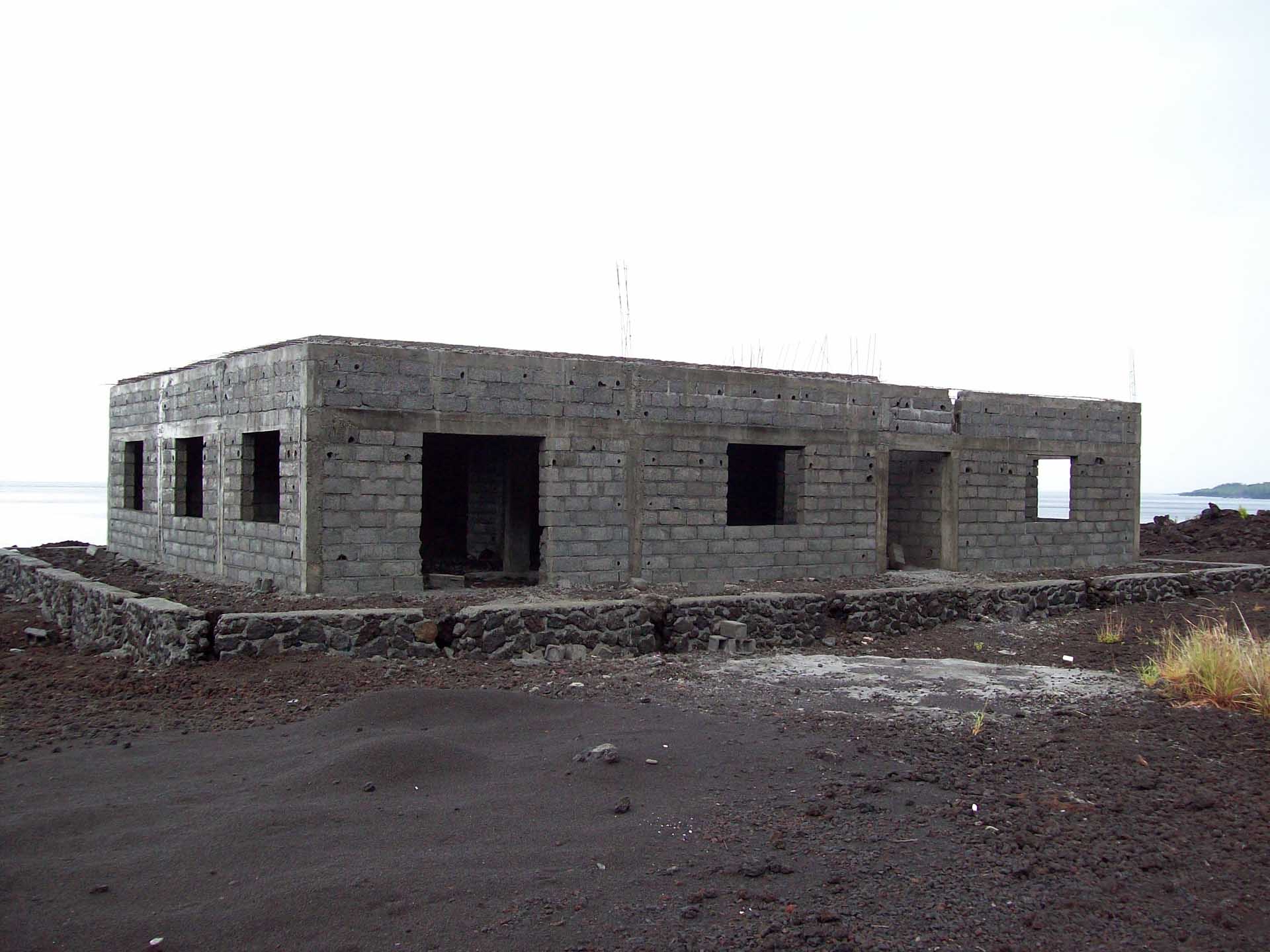
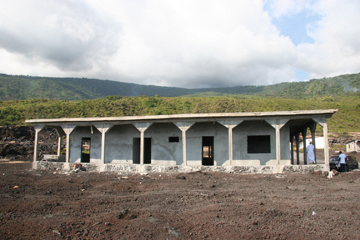
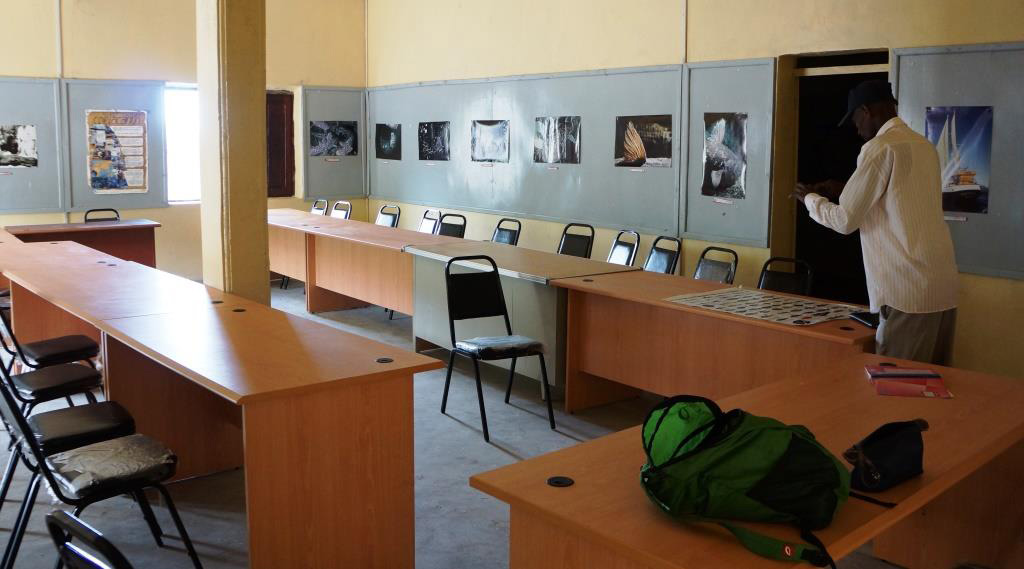
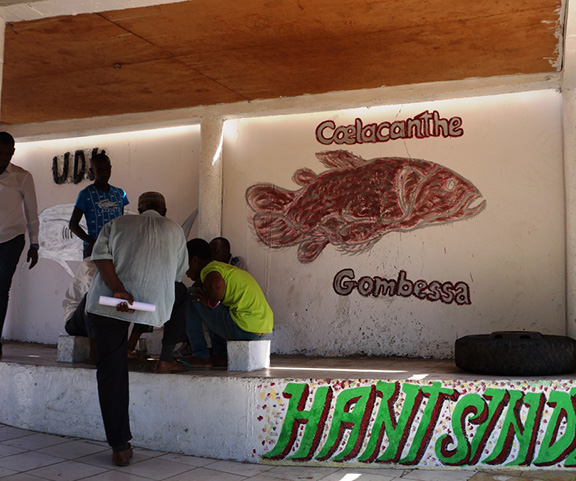
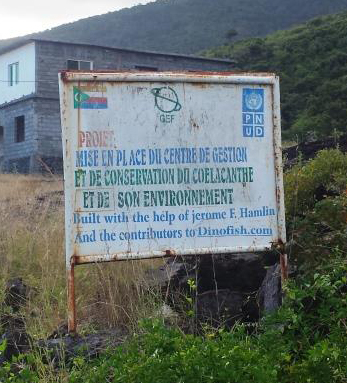
The coelacanth educational center, situated on a lava flow mere meters from where coelacanths actually live in submarine caves off the Comoro Islands, was built by contributors to this site (see bottom of this news page.) Still functioning six years after its official opening in 2011, this is where I did my historic "Descent to Cave 4" -linked off the Recent History page- at a time when fewer people had seen coelacanths at depth than had walked on the moon!
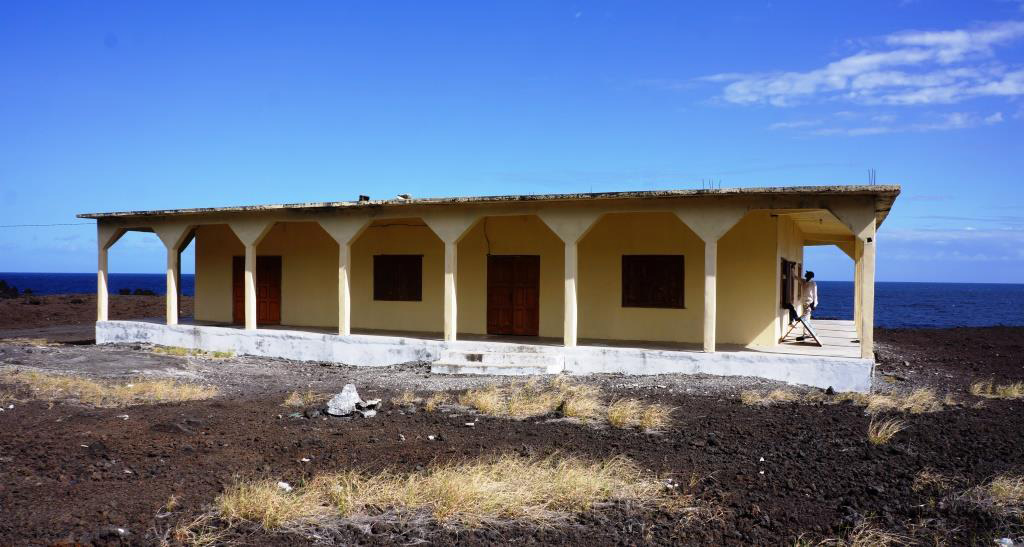
(Photos courtesy Galina Vorona 2016)
Rik Nulen's Coelacanth News Summary 2016 1) We had to say farewell to Peter Lawrence Forey (1945-2016) who left us on January 21st, 2016 after a long illness. Peter was a phylogeneticist and fish palaeobiologist for many years at the Natural History Museum of London (UK). Peter was also interested in Coelacanths and many of us know his famous work “History of the Coelacanth Fishes” which appeared in 1998.
2) During the year 2016, we made some interesting discoveries of coelacanths which one can find in the update number 6 to the global inventory published in 2011.
In a museum in the little town called Comiso on the Isle of Sicily (Italy) in the Mediterranean Sea, a coelacanth skull was discovered in a hardboard box in the basement of the museum. The skull wrapped in old newspapers.
3) On the other Coelacanths in Italy, we can mention that the three coelacanths in the Museum of Torino are ‘out of view’ since the Museum has closed since August 2013, due to security reasons and rebuilding. Attempts of Dr. Erik Domini, who collected these specimens, for bringing them temporarily to the Museumof Asta where he lives were unsuccessful.
4) The museum in Trieste has celebrated on 10th of December the fact that 35 years ago they put their Coelacanth specimen on display.
5) In 2003, the Museum of Schönebeck in Germany got a replica of a coelacanth - apparently made from the original specimen in Vienna. Later, in 2011, they got a ‘real’ Mozambique juvenile, donated by Prof. Hans Fricke. However, due to reorganizations, there is no longer place for coelacanths in the current setup of this Museum. Coelacanths just don’t fit in the actual presentation ‘Salt winning’ and ‘Inland waterway Transport’. [Source: Die Volksstimme, 12.01.2016]
6) Tourists discovered a coelacanth in a holiday residence at Sarodrano (Madagascar). Another tourist found two coelacanths in a box on a farm close to Moroni(Comoros).
7) The specimen CCC4, originally stored at the Biological Institute of the University of Antananarivo has been (re)found in the Museum at Tsimbazaza-Antananarivo. It was at this place, Tsimbazaza that the Institute was built after the ideas of French scientist Jacques Millot.
8) In August 2016, the Indonesian specimen CCC299 (for details see: Update 4, dd. 28 December 2014) went to the Fukushima Aquamarine in Japan for dissection and study under supervision of Masa Iwata.
Coelacanth News 2015
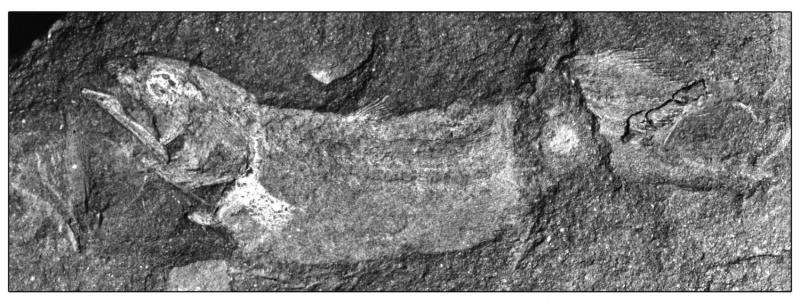
Monday, 21 September, 2015 Environment news Africa's earliest known coelacanth found in Eastern Cape, South Africa Various specimens of Africa's earliest coelacanth have been found in a 360 million year-old fossil estuary near Grahamstown, in South Africa's Eastern Cape. Dr Robert Gess, who analysed the specimens of the new fossil species Serenichthys kowiensis while completing his PhD at Wits University, said: "It is the earliest record we have of the breeding behaviour of coelacanths. Estuaries are today used by fish in exactly the same way." "This glimpse into the early life history of ancient coelacanths raises further questions about the life history of the modern coelacanth, Latimeria, which is known to bear live young, but whether they, too, are clustered in nurseries remains unknown," explains Professor Michael Coates of the University of Chicago, who has helped describe the new species.
"NEW" FOSSIL COELACANTHS CATALOGUED IN U.K.,WHERE THE VERY FIRST WERE FOUND IN 1836
The coelacanth fish, found today in the Indian Ocean, is often called a 'living fossil' because its last ancestors existed about 70 million years ago and it has survived into the present - but without leaving any fossil remains younger than that time. Now, some much older coelacanth remains have been uncovered in a fossil deposit near Bristol by a student at the University of Bristol.
While working last summer in Bristol's School of Earth Sciences, Harry Allard, a recent graduate from the University of Exeter, found remains of coelacanth fishes, ranging in size from juveniles to adults, in a section of Late Triassic rocks, dated at about 210 million years old, at Manor Farm, Aust, close to the first Severn crossing. He discovered the new fossils in a large collection of fish and reptile teeth and bones, representing animals that lived in the shallow seas, and on the neighbouring landmass at that time when Bristol teemed with dinosaurs, and the landscape consisted of numerous tropical islands.
Harry said: "These fossils provide an amazing glimpse of an ecosystem which is so different from the contemporary landscape of south west England. It has been fascinating to look at the changing composition of that long-lost ecosystem."
The Manor Farm site was created 15 years ago when the second Severn crossing was under construction and contractors excavated there to obtain road-building materials. After the site was made safe, a section was dug out so geologists, and the public, could visit and learn about the local geology. One of the fossil collectors at the time, the late Mike Curtis of Gloucester, collected batches of sediment, and worked through the material to extract nearly 20,000 teeth and bones.
"Mike Curtis kept such excellent records that Harry was able to separate the collections into findings from five separate bone beds, each perhaps separated by a few hundred thousand years," said Professor Michael Benton, supervisor of the project. "This provides unique insight into a turbulent time, when seas flooded across the landscape, submerging much of Europe. Dry land became shallow seas almost overnight, and the energy of the floods churned up the soil and rock below and deposited bone beds in some places."
Tracking upwards through the five bone beds, Harry was able to show how the fish faunas changed through time, from being dominated by small sharks at first, and then switching to more thick-scaled bony fishes higher up.
"The coelacanths were smaller than the living coelacanth Latimeria," said Chris Duffin, a fossil fish expert who was involved in the work, "but these fishes were quite diverse in the Triassic, and only dwindled in importance later. They are most unusual, having gills and lungs, and moving both by paddling with their gills, and stilt-walking along the seabed as well."
More information:Microvertebrates from the classic Rhaetian bone beds of Manor Farm Quarry, near Aust (Bristol, UK)' by Harry Allard, Simon Carpenter, Chris Duffin, and Michael Benton in Proceedings of the Geologists' Association.
Provided by: University of Bristol (Courtesy of Amb Mahmoud Aboud)
Rik Nulen's Coelacanth News 2014
Rik Nulen's Coelacanth News 2014
1) The tragic loss of Peter Timm, a name synonymous with coelacanths and conservation has shaken the diving, scientific and conservation community in South Africa and the world on June 18, 2014.
Peter (51) and his buddy Adele Steegen (45) died in a diving accident while helping find research equipment that was lost during a research cruise in 58m depth of water off Umkomaas near Aliwal Shoal. The equipment, owned by the Oceanographic Research Institute, was being used to sample biodiversity on the seafloor, as part of a multi-institutional collaborative conservation research programme led by Ezemvelo KZN Wildlife. Peter was well known with his co-discovery of the South-African Coelacanths in Sodwana Bay in October 2000. Adele was the first SA woman - and second woman ever - who was able to share some ‘great moments’ with a Coelacanth, named ‘Grant’, on March 5, 2014 at a depth of 116 metres. Peter and Adele were also team members of the great international coelacanth dive expedition held last year.
They are gone now from this world - forever - but never to be forgotten. Coelacanths will always help us to remember their names!
2) A fourth overview of changes/additions to the Smithiana publication ‘An updated inventory of all specimens of the coelacanth, Latimeria chalumnae spp.’ is also with this mail.
3) A coelacanth has been caught at Gangga Island, North Sulawesi (Indonesia) early November 2014. It is the seventh specimen caught in Indonesia. No further catches were recorded in the Comoros, Tanzania or Madagascar as far as I know.
4) Same as last year, many articles were published on genetic research on coelacanths. There were even several magazine editions specially dedicated on coelacanth research like the Japanese magazine Iden Genetics (120pp) and the Journal of Experimental Zoology - Part B: Molecular and Developmental Evolution (135pp), both editions with many specific articles. See the Bibliography for details.
5) A new translation of Samantha Weinberg’s book ‘A Fish Caught in Time’ (1999) was published in August 2014. Now it is the translation in the Dutch language. Beside the original English Edition (UK & US) one can find and buy now Samantha’s book in German, Swedish, Japanese, Chinese and Dutch language.
6) As mentioned last year, there was a great scientific expedition in South Africa. The French TV station Arte France TV in cooperation with Gill Kebaili and diver Laurent Ballesta now presented their video “GOMBESSA”. There exists a long (90 minutes) and a short version (60 minutes) of this video.
7) Director Yoshitaka Abe and Coelacanth expert Masamitsu (Masa) Iwata from the Japanese Aquarium “Aquamarine Fukushima” also presented their Coelacanth book in 2014 with the title: “Coelacanth no Nazo - Rikujyoo Seibutso no Idensha metsu Sakana”. Only available in Japanese.
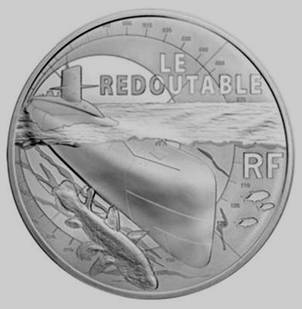
8) The French “Monnaie de Paris“ brought two new coins on the market in the series “Marine History”. The coins of 10 Euro (silver edition) and 50 Euro (silver and gold edition) are depicting the nuclear submarine “Le Redoutable” with a coelacanth beside.
DINOFACE!
With a fishface only a mother could love, a coelacanth fronts the cover of an American Scientist article on arrested evolution.
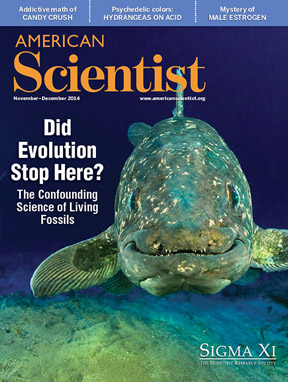
The discovery of a living species of coelacanth, a lobe-finned fish recognized as an important transition in vertebrate evolution, was a surprising and exciting find in 1938, because the fish was already widely recognized in the fossil record. Hailed as a living fossil, even though there has never been any fossil find of the two extant species of coelacanth, it is native to waters around Indonesia and in the Indian Ocean. Although fossil and extant coelacanths look strikingly similar, they do not demonstrate an absence of evolution. In “The Evolutionary Truth About Living Fossils” (pages 434–443), Alexander J. Werth and William A. Shear relate the unseen evolution of living fossils and discuss the definition and usefulness of this term, first coined by Charles Darwin. The image on the cover shows a face-to-face encounter between a coelacanth off the coast of South Africa and the renowned diver and naturalist Laurent Ballesta. (Photograph by Laurent Ballesta.)
Reading the article requires a subscription.
courtesy Rik Nulens
June, 2014. In a sad development, Peter Timm and a diving companion, Adele Stegen, lost their lives in a freak diving accident at Umkomaas, SA, where they were under contract to recover scientific equipment lost by a research vessel. Both were considered among the best technical divers in South Africa. Timm was one of the discoverers of the South African coelacanths in 2000. Stegen was the first South African woman to see coelacanths in their natural habitat. See article on the South African discovery.
In an April 17th, 2013, article in Nature, the authors (Chris Amemiya, a biologist at the University of Washington in Seattle, and Kerstin Lindblad-Toh, a comparative genomicist at Uppsala University in Sweden) who have worked on coelacanth DNA sequencing of the African coelacanths, Latimeria chalumnae, claim that the coelacanth's genes evolved more slowly than those of other studied fishes and vertebrates , including shark's, perhaps because of lack of predation and a stable environment. The research appears to add some validation to explanations that have already been speculated. Unfortunately for "Coelie" fans, they find the lungfish still seems the more likely vertebrate ancestor.
Project Gombessa
A French Dive group, led by Laurent Ballesta, the same team that did the recent photos and film footage used by National Geographic, completed a new series of dives during a 33 day expedition at the Sodwana, South Africa, coelacanth habitat. They concluded by attaching a GPS to a coelacanth for tracking. The expedition was financed by Swiss watchmaker Blancpain. Some of the pictures and video appear at an exhibit sponsored by the company at the United Nations in NYC.
Coelacanth News 2012
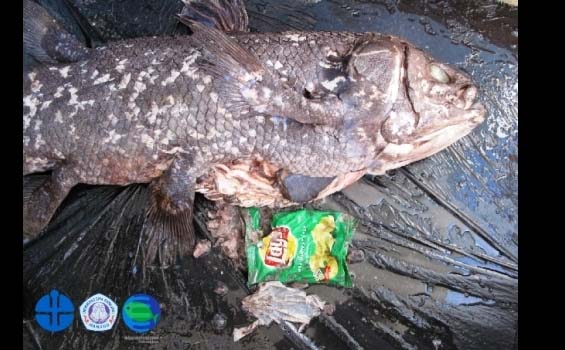
Living Fossil EATs Junk Food!
On the 24th of May, 2012, an Indonesian/Japanese team of researchers reportedly "felt very sad" when they discovered plastic garbage in a coelacanth specimen’s stomach. The specimen had been caught, July, 2011, in Indonesian waters. The fish showed a preference for Lay's Classic Potato Chips! The news was aired by the Manado Tribune on May 29, 2012.
Triton Dive Charters found several coelacanths during their Sodwana Coelacanth Expedition, March 2012. Coelacanths were found on 3 occasions (5 mixed gas dives were undertaken). On March 6, Peter Timm and his team encountered ‘Noah’, the 14th coelacanth, in Jesser canyon. Later, more coelacanths were seen and filmed/photographed. (Courtesy: Rik Nulens)
During these dives, Eve Marshall, became the first woman to dive deeper than 100 m, using SCUBA, to see this special fish in its natural environment. (Courtesy Kerry Sink) Editor's note: Deep mixed gas diving is extremely dangerous, with long decompression times, and has involved multiple fatalities and near fatalities in search of the coelacanth. Don't try this at home! -JH
National Geographic Channel ran a program centered on the Sodwana coelacanths, "Preserving the Specimen." For background on the Sodwana coelacanths click here.
Coelacanth News 2011
Japanese scientists claim Tanga coelacanths genetically distinct from Comorian cousins.
( Nov. 10, 2011 ) Researchers from the Tokyo Institute of Technology and other entities said the newly found breeding group of Tanga coelacanths linked to the site, has existed for more than 200,000 years without genetic contact with other groups.
The team published the results in an online edition of the Proceedings of the National Academy of Sciences of the United States.
Tokyo Institute of Technology Prof. Norihiro Okada and his colleagues analyzed genes of more than 20 coelacanths caught off Tanga, northern Tanzania, and nearby sites. The areas are nearly 1,000 kilometers north-northwest of the Comoros Islands.
The results showed the fish belong to a population genetically distinct from that off Comoros Islands.
The two groups seem to have separated 200,000 to 2 million years ago, the researchers said.
Considering the number of fish caught, the researchers assume the newly discovered population may comprise hundreds of coelacanths near the site.
This finding conflicts with the claims of German scientists that the Sodwana, South African coelacanths are genetically the same as the Comoran species. (See articles linked from the Recent History page of dinofish.com)
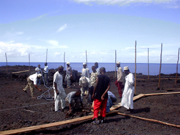
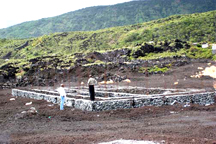
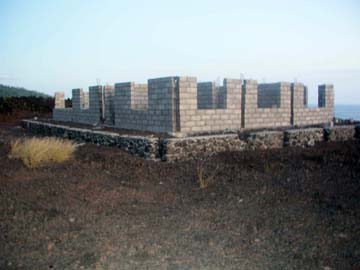
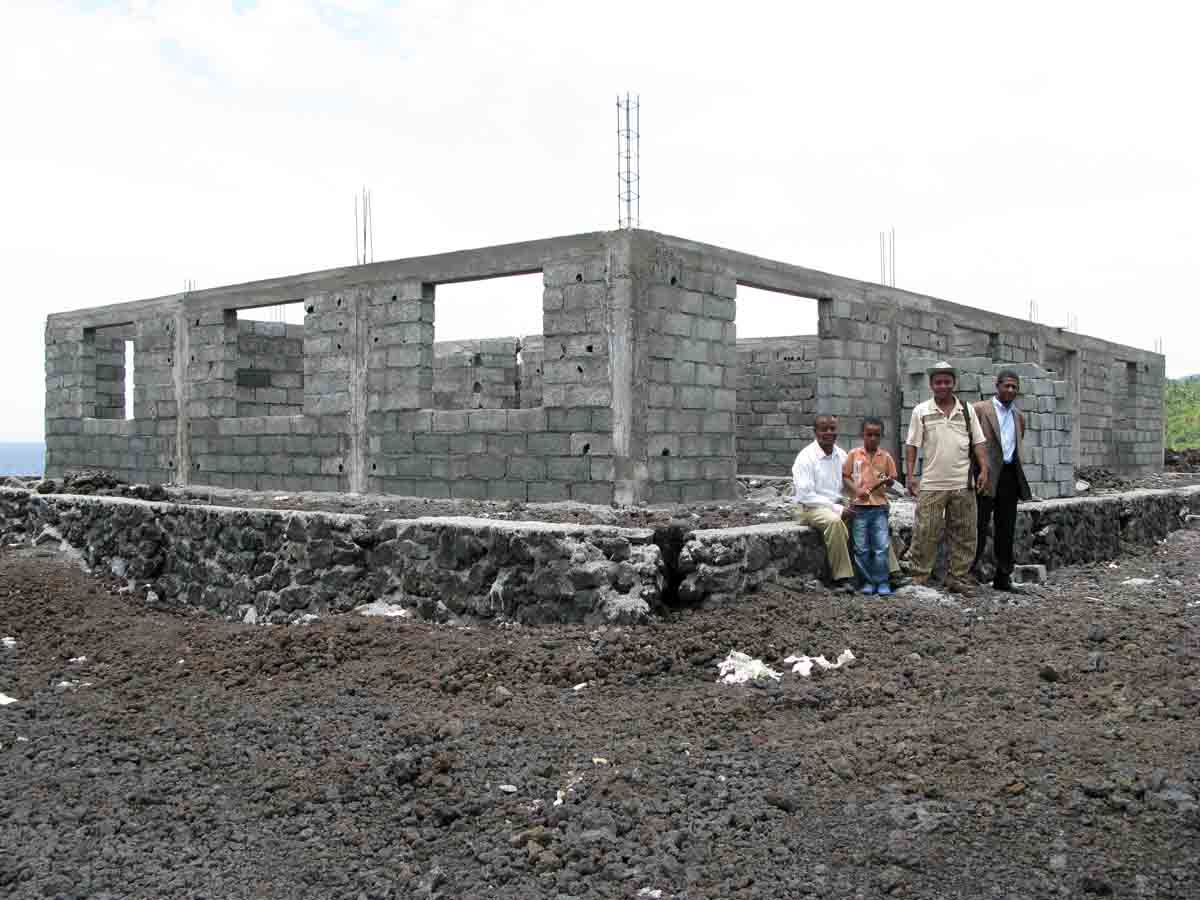
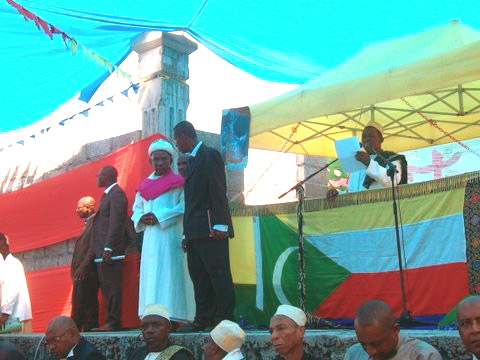
One small step for a fish! The Coelacanth Rescue Mission (CRM), funded by contributors to this web site via Coelashop purchases, initiated financing for a coelacanth research center (CoelaCenter) at Itsoundzou, a fishing village on Grand Comoro island in the Indian Ocean. The center is within several hundred feet of where the largest and most studied colony of coelacanths reside by day in their submarine caves. It is being built and will be operated by APG, a local group supporting coelacanth conservation. The center will be used to increase conservation awareness locally, and conduct ecological research. It will also be a museum dedicated to the history of the coelacanth. Groundbreaking began in April '04. By winter '08, thanks entirely to "coelashoppers" walls were completed for the first floor. In Feb. '08, the Comoros office of the United Nations Development Project (UNDP) Global Environment Facility/ Small Grants Programme, agreed to finance the next phase of the Center's completion, an exciting giant leap for the center and the people of Itsoundzou.. (Pictures courtesy Said Ahamada, Mahmoud Aboud and Jerome Hamlin) Further contributions welcome via the Coelashop.