|
Click here for a printable version of this page. The National Geographic Society, Nature, and the Smithsonian Institute jumped on the bandwagon decreeing a news embargo which kept the coelacanth research community in the dark for another year. During this time a conservation program was set up by the Erdmann's. On July 30th, 1998 a second specimen was brought live to Dr. Erdmann. An attempt was made to keep the fish alive by dragging it through the water. This effort failed (see "divers attempt to revive dying coelacanth" under 'CONSERVATION'), however, this second specimen confirmed the find and led to the press release of September 24th, 1998, and subsequent world wide attention. North Sulawesi is some 10,000 kilometers from the Comoros with no apparent water current interactions. This population would appear to be completely isolated from the Comoran coelacanths whereas recent catches off of Madagascar and East Africa have not been eliminated as possible strays or satellite colonies. The Indonesian fishermen had long called their coelacanth "Rajah Laut" (King of the Sea). The observed specimens appear identical to the Comoran coelacanth, Latimeria chalumnae. Initial reports that they were brown, apparently resulted from the observation of dead specimens. DNA comparisons were performed and appear to confirm a new species of coelacanth which has been named Latimeria menadoensis. The Indonesian authorities declared their willingness to cooperate with several conservation initiatives, however, futher bycatches would be kept for research. It was ten years before the next catch was reported.
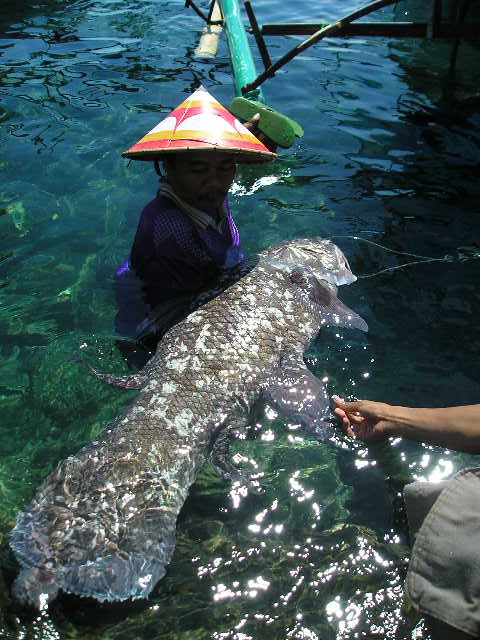
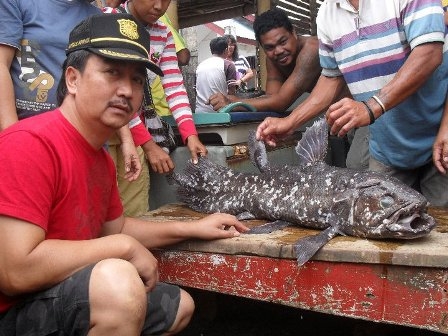
More Coelacanths Caught in Indonesia. After almost ten years, another coelacanth was caught in Indonesia.On May 19, 2007, a fisherman named Justinas Lahama and his son Delvi Lahama, caught a four foot, 110lb coelacanth off Manado Bay, North Sulawesi province. It lived for 17 hours in a quarantined pool. While this has been attempted several times in the Comoros with a similar survival rate, the May 19 resuscitation attempt is the first known effort in Indonesia. The fish was caught near the Bunaken National Marine Park, where fishing with shark nets has been banned for almost a decade. This catch made the international wire services! Meanwhile, on September 17, 2009, the Indonesian newspaper KOMPAS reported that another coelacanth had been caught by fishermen on Wednesday 16 September 2009, around 06:00 in the Gangga waters, Likupang, North Sulawesi, Indonesia, about 90km from Manado. The coelacanth was still living when caught (with a net) and measured 114cm. Alex Masengi from Sam Ratulangi picked up the specimen for further investigation. (Rik Nulens) As of 9/02/11 five more coelacanths had been caught since the second one identified by the Erdmanns. Here's the complete listing of reported Indonesian catches to that date: (courtesy researcher, Rik Nulens.) 1) 18 September 1997, (CCC174), seen by Arnaz & Mark Erdmann-Mehta on a fish market in Manado Capture site Manado Tua, Kampung Negeri, length ca 130cm 2) 30 July 1998, (CCC175), capture site Manado Papindan village, length ca 124cm, female 3) 19 May 2007, (CCC215), capture site Malalayang, near Bunaken National Marine Park, length 131cm, female, 25 small eggs (3cm) 4 )25 November 2008, (CCC225), capture site North of Talise Island, Minahasa Utara, North Sulawesi, length 110cm 5) 16 September 2009, (CCC…), capture site Gangga waters in North Sulawesi Province, off Sulawesi Island, length 114cm
Photo by Hentje Lumentut, a journalist of Manado Post (Jawa Pos News Network) 6) Capture Date: 21 July 2011. 17:00h. Capture Place: Tatapaan, Amurang – Minahasa, Sulawesi Utara, Indonesia. Fisherman’s name: Oktavianus Cowan Kawalo Weight: 13.1kg. Length: 105cm. Condition on capture: alive, dying 1.5 hrs later on the boat Method of preservation: Frozen. Condition after capture: Good. First ref. cited: Tribun Manado, 22 July 2011. Current Holding: South Minahasa Fishery Office Additional comments: Pictures taken. Descriptive name Indo 6. The fisherman went to the Tumpaan fish market where the specimen was recognized by Jefri Lamia as the protected Latimeria. Then the authorities from DKP (Department of Marine and Fisheries of North Sulawesi province) were informed and Mr. Arifin Kiay Demak came immediately to the Tumpaan fish market and took the coelacanth with him to freeze it. (Courtesy Rik Nulens)
In the coming years, more coelacanths were caught in Indonesia, including at Raja Ampat, a famous SUUBA diving and sportfishing area. In fact, one coelacanth was caught by a sportsfisherman while angling. Coelacanths were observed by ROV as far east as Biak, Indonesian Papua.
|
|||
|
|
|||

|
 |
|